How to Read Swedish Household Examination Records
Swedish household examination records list everyone who lived in a parish, household by household. This guide explains what the columns, marks and abbreviations mean, and how to follow a family back one book at a time.
Facts checked against sources, November 2026
On this page
- What is a household examination record?
- Why the household examination record matters when you trace your Swedish family
- Timeline
- How to read a page
- Marks and abbreviations
- Marks for moves, vaccination and family
- The titles you will see before the names
- Step by step: follow a family
- Pitfalls
- Glossary
- Common questions
The essentials in one minute
- From 1686, Swedish priests had to keep a household examination record of everyone in the parish7.
- The whole household is on one page: parents, children and servants11.
- The record shows where people were born and where they moved, so you know where to look next9,10.
- A new book was started every five to ten years, and from about 1895 the book is called a parish book8,11.
- You can read the records in the Swedish National Archives' Digital Research Room2,9,10.
What is a household examination record?
In Swedish it is called a husförhörslängd. You may also see it called a household examination roll or a clerical survey1,3.
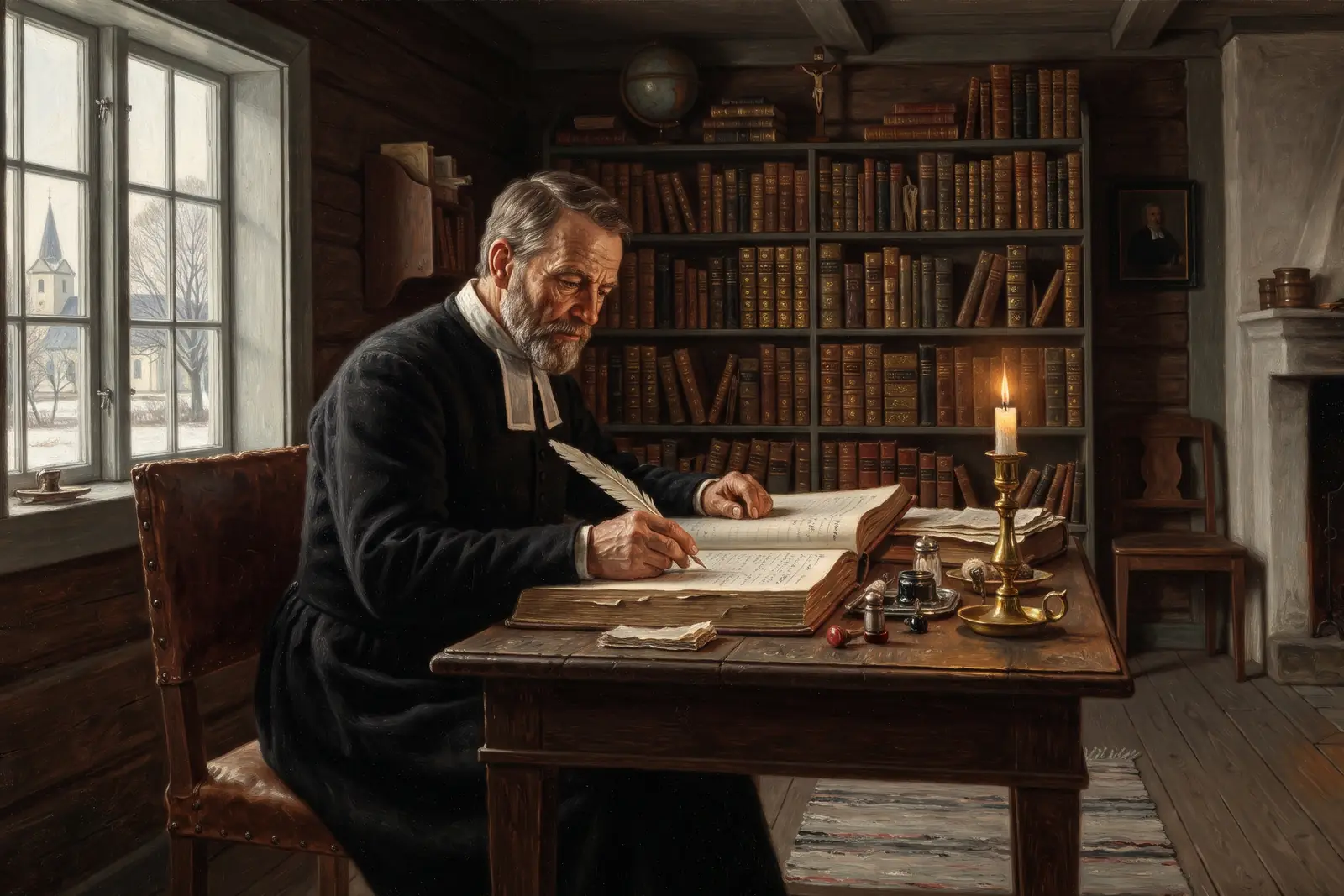
It is the priest's book of everyone who belonged to the parish8. In Sweden, the Lutheran state church kept the population register, so the parish priest was also the local registrar7,8. A law from 1686 told the priests to keep these records for the whole population7.
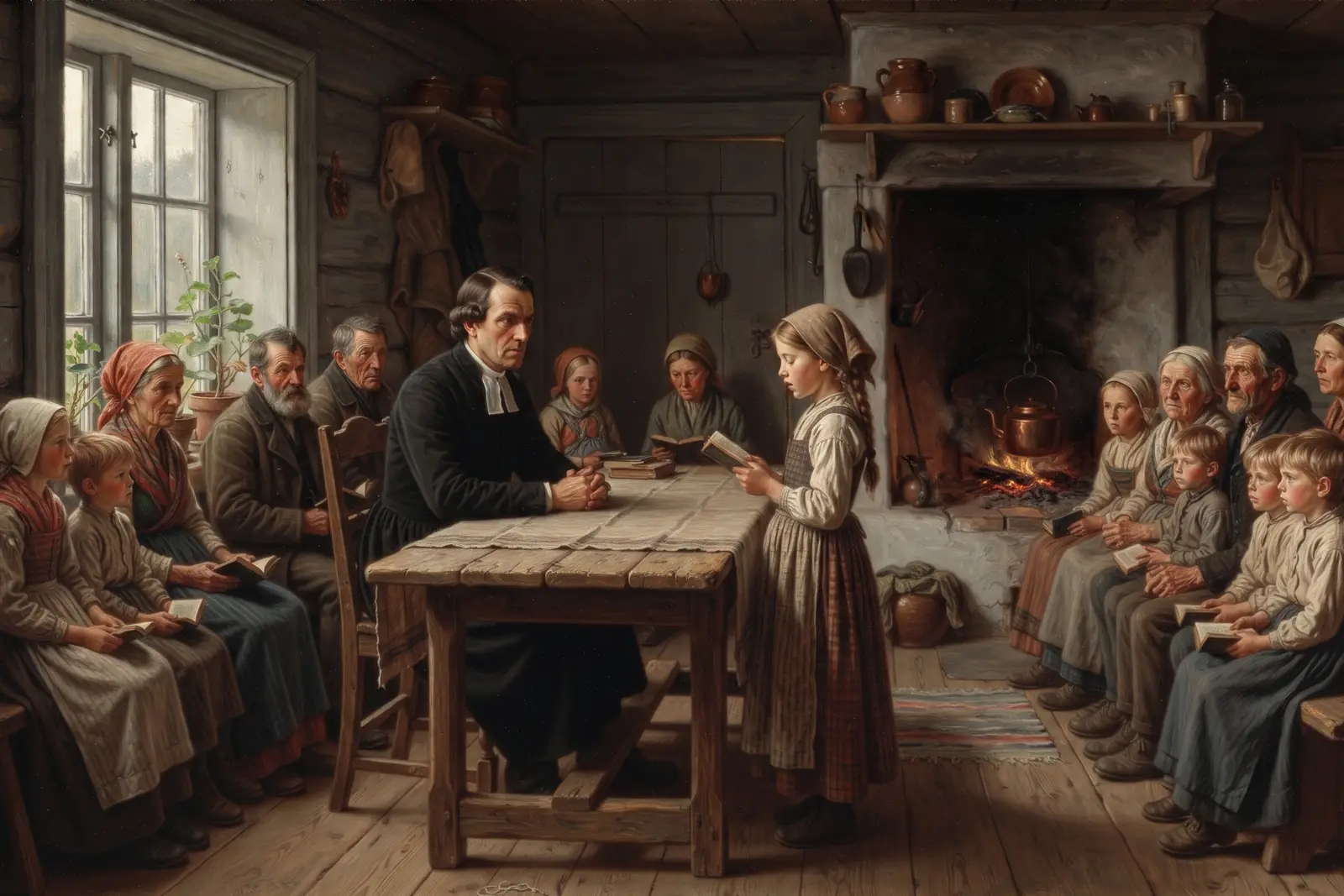
The book was arranged household by household8, by village, farm and croft10,14. The name comes from the husförhör (household examination): the priest visited the homes and tested how well people could read and how much they knew of the Christian faith12.
Why the household examination record matters when you trace your Swedish family
- You see the whole household at once – parents, children and servants on the same page9,11.
- You can follow the family year by year. The record is the main book of the old Swedish population register. Facts from the other church records were gathered in it9,10.
- You get the date and parish of birth for each person, which tells you where to look next9.
- You see when and where they moved. From about 1820 the books had columns for moving in and moving out11, and the old book often gives the page in the new one11.
- You learn more than dates: the occupation (usually written before the name)11, reading ability11, communion12, smallpox vaccination11 and the priest's own notes12.
Timeline
- 1608
Archbishop Olaus Martini urged the priests to record baptisms, weddings and betrothals. It is the first known order about church records in Sweden15.
- 1622
Bishop Johannes Rudbeckius gave detailed rules for the church records in the diocese of Västerås, including the first rules in the country for examination records15.
- 1686
The first church law for the whole country. Priests now had to keep household examination records of the whole population7.
- 1697
A household examination book begins in Revsund, in the province of Jämtland. The pages were found in the church in modern times and show that records existed earlier than the archive knew13.
- 1726
A royal ordinance of 12 January 1726, the Konventikelplakatet, ordered household examinations in the whole country. Some time into the 1700s, the examination records came to be called husförhörslängder15.
- 1749
Sweden's first population statistics, the Tabellverket, began. The household examination record then became a full list of everyone living in the parish15.
- 1752
The officials who listed the population for taxes were given the right to read the household examination records in the whole country15.
- 1780s
Printed forms came into use. Before that, the books were handwritten from start to finish11.
- 1812
Farm owners and users had to report in writing who lived on their land, partly so that the examination books would be complete15.
- About 1820
The books got columns for moving in and moving out11.
- 1860
A royal circular of 27 April 1860 set a form for the household examination records. One book could be used for five or ten years15.
- 1894
A new ordinance on church registration. Over six years, the household examination records were replaced by parish books15, which is the name from about 18958,10.
- 1991
From 1 July 1991, the Swedish Tax Agency keeps the population register7.
How to read a page
At the top is the village and the farm or croft10,14. Then comes the household: the head of the household first, the servants last11. The forms changed over time11,15, so the columns vary between books. The usual order:
- Occupation or standing – usually written before the name11.
- Name, birth and marriage – the date and parish of birth, and the wedding date9,10.
- Reading and knowledge of the faith – the priest's marks11.
- Presence at the examinations – one column per year11.
- Communion – when the person went to communion11,12.
- Smallpox vaccination – from the early 1800s11.
- Moving – where from and where to, from about 182011.
- Death – the year10.
- Remarks – the priest's own notes12.
Marks and abbreviations
The columns were narrow, so the priest wrote short. These are the marks for reading and presence that the sources explain. The reading marks differ between parishes11.
| Mark | Meaning |
|---|---|
| väl, temligt, något | Well, fairly, somewhat: how well the person understood what was read (diocese of Västerås, rules of 1622)15 |
| bra, god, svag | Reading marks written in words, 1800s11 |
| bryggan, dashes or crosses | Reading marks written as signs instead of words, 1800s11 |
| N | Was at the examination11 |
| sjuk, aegr | Absent because of illness (aeger is Latin for sick)11 |
| abs | Absent (Latin absens)11 |
| scholan, militärtjänst | Away at school or in military service11 |
Marks for moves, vaccination and family
| Mark | Meaning |
|---|---|
| f. Bond. | Former farmer, who has handed over the farm11 |
| f s s | För sig själv (on his or her own): the child is written outside the parents' household11 |
| v, vac, ymp | Vaccinated against smallpox (ympad is old Swedish for inoculated)11 |
| s | Has had smallpox11 |
| infra, supra | See below, see above: moved within the parish11 |
| Name crossed out | Moved from the page11 |
| Dotted or wavy line under a crossed-out name | Moved back to the same page11 |
About deaths: a death is noted in the household examination record, but the reliable date is in the death and burial record11.
The titles you will see before the names
The occupation column tells you a lot about how the family lived. These words are common in household examination records. Each one has its own page in the glossary.
- Bonde – farmer. Hemmansägare – farm owner, a farmer who owned the farm16.
- Torpare – crofter. He farmed a small piece of someone else's land and paid with days of work16.
- Backstugusittare – a poor cottager who lived in a small cabin on a landowner's land5.
- Inhyses – a lodger on a farm, usually not closely related to the family there5.
- Statare – a married farm laborer on a large estate, paid mostly in goods6.
- Dräng and piga – farmhand and maid, hired for a year at a time; farmhands were usually unmarried5.
Step by step: follow a family
Find the parish.
You must know in which parish the person was born9.
Go to the same village and farm in the household examination record.
There you find the whole household, and the parents' dates and parishes of birth9.
Do the same for the parents.
Go to the mother's and father's parish of birth and start again. That takes you one generation further back9.
Pitfalls
The same person, different names.
Someone baptized Johannes may have married as Jan and died as Johan. The priest decided the spelling and the form of the name9.
The same person twice.
A person can be written in more than once, even on the same page and line11.
The occupation can be old.
The priest did not always change it when it changed. The mantalslängd (tax register) more often has the latest occupation11.
Newer records are protected.
For people born within the last 70 years, you may need to ask the archive staff9.
Glossary
- husförhörslängd
- Household examination record: the church book of everyone in the parish, at first kept household by household8.
- husförhör
- Household examination: the priest's test in the homes of reading and knowledge of the faith12.
- församlingsbok
- Parish book: the name from about 1895 for what was earlier called a household examination record8.
- backstugusittare
- A cottager on a landowner's land5.
- hemmansägare, bonde
- Farm owner, farmer3,16.
Common questions
What is a Swedish household examination record?
The priest's book of everyone in the parish, arranged by village, farm and household. Priests had to keep it from 16867,8.
Is a clerical survey the same thing?
Yes. Household examination record, household examination roll and clerical survey are English names for the same Swedish book, the husförhörslängd1,3.
Where can I see household examination records?
In the Swedish National Archives' Digital Research Room (in Swedish Digitala forskarsalen), where you search the church archives by county and parish1,2,9,10.
When do household examination records end?
An ordinance of 1894 replaced them with parish books over six years15; from about 1895 the book is called a parish book8,10.
What do the letters in the reading column mean?
They are the priest's marks for reading and knowledge of the faith – in words (bra, god, svag) or in signs that differ between parishes11.
Why is my ancestor's name crossed out?
Usually because the person moved from the page11.
Why does my ancestor have different first names in different books?
The priest decided the spelling and the form of the name – Johannes, Jan and Johan can be the same person9.
Sources
Sources in English
- Riksarkivet (the Swedish National Archives): Genealogy – sok.riksarkivet.se
- Riksarkivet (the Swedish National Archives): Digital Research Room – sok.riksarkivet.se
- Hans Högman: Genealogy terms A–R – hhogman.se
- Hans Högman: Genealogy terms S–Ö – hhogman.se
- Hans Högman: The Old Agricultural Society – hhogman.se
- Hans Högman: Statare – hhogman.se
Sources in Swedish
These pages are in Swedish.
- Skatteverket (the Swedish Tax Agency): Folkbokföringens historia (in Swedish) – skatteverket.se
- Skatteverket: Ordförklaringar, Sveriges församlingar genom tiderna (in Swedish) – skatteverket.se
- Riksarkivet: Om släkt- och personforskning (in Swedish) – sok.riksarkivet.se
- Riksarkivet: Kyrkoarkiv (in Swedish) – sok.riksarkivet.se
- Umeå University (CEDAR): Kyrkböcker. 1800-talets kyrkoregister, Ulla Nilsdotter Jeub, 2019 (in Swedish) – umu.se
- Håkan Liby: Själavård, husförhör och folkbokföring, Uppland yearbook 1991 (in Swedish) – aarsbokenuppland.se
- Riksarkivet: Okänd husförhörsbok från 1600-talet påträffad (in Swedish) – riksarkivet.se
- Church of Sweden: Kyrkböckerna följer familjer under lång tid (in Swedish) – svenskakyrkan.se
- Skatteverket: Den svenska folkbokföringens historia under tre sekler (in Swedish) – skatteverket.se
- Landsarkivet i Uppsala (Riksarkivet): Hur hittar jag mitt torp i arkiven?, Gunilla Lundberg Ehnström, 2008 (in Swedish) – webbutik.riksarkivet.se