What does statare mean?
Statare has no single English word, so this page explains what it means and keeps the Swedish word. A married farm laborer on a large estate, hired for a year and paid mostly in goods, called stat.
- Swedish
- statare
- Also seen as
- statarhustru, stat
- Group
- Occupations and social standing
Definition
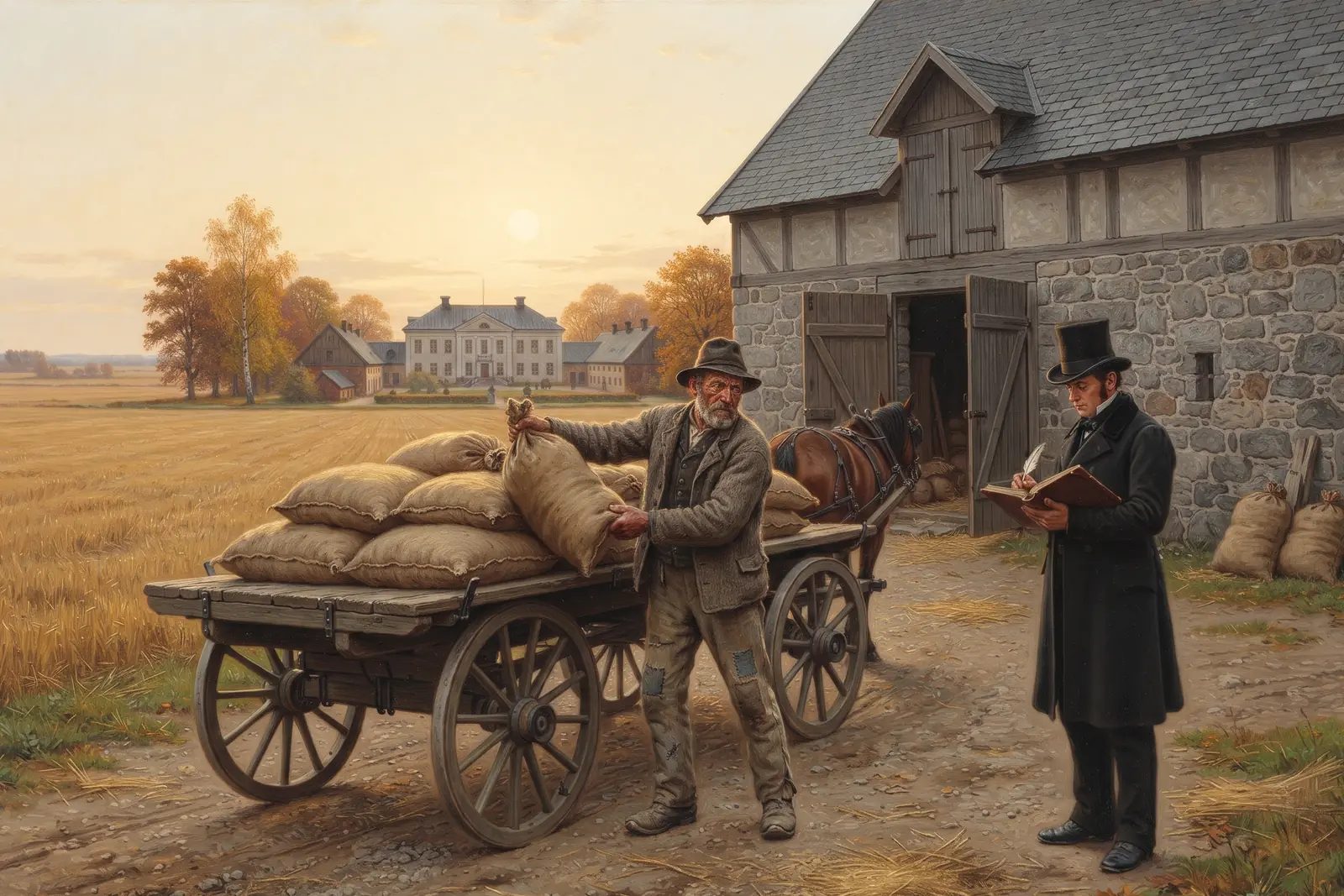
A statare was a married, poor farm laborer who owned no property, land or animals1. He was hired for one year at a time on a large estate and paid mostly in goods1. The pay in goods was called stat: lodging, firewood, grain and milk1. There was no such worker in the English-speaking world, so there is no good English word2.
In the records
The title stands before the name in the household examination record3. Statare moved often between estates, and Högman calls them the nomads of the Mälardalen region1.
What it meant
The whole family worked for the estate1. The lodgings were often cold, damp barracks with one room that was also the kitchen1. Families moved in the last week of October, which Högman says was called slankveckan, the "slim week" or "hungry week"1. The statare system began in the middle of the 1700s1,4, peaked at the end of the 1800s1 and was abolished on 1 November 19451,5.
Do not confuse with
A torpare (crofter) had his own croft, cattle and fields and paid with days of work; a statare owned nothing and was a hired laborer1. A dräng (farmhand) was usually unmarried2.
Related
- torpare – A crofter – a man who farmed a small holding on someone else's land and paid for it with days of work.
- dräng – A farmhand – a male servant on a farm, usually unmarried and hired for one year at a time.
- backstugusittare – A poor cottager who lived in a small cabin on someone else's land, with no land to farm.
- Guide: How to Read Swedish Household Examination Records
Sources
Sources in English
- Hans Högman, Statare – hhogman.se
- Hans Högman, The Old Agricultural Society – hhogman.se
Sources in Swedish
These pages are in Swedish.
- Umeå University (CEDAR), Kyrkböcker. 1800-talets kyrkoregister, Ulla Nilsdotter Jeub, 2019 (in Swedish) – umu.se
- Länsstyrelsen Skåne, De obesuttna (in Swedish) – lansstyrelsen.se
- Erik Magnusson, En social omvälvning på 1940-talet, Uppland yearbook 1979 (in Swedish) – aarsbokenuppland.se
Facts checked against sources, November 2026.