What does torpare mean?
In Swedish records, torpare means crofter: a man who farmed a small holding on someone else's land and paid for it with days of work.
- Swedish
- torpare
- In English
- crofter
- Also seen as
- torp, torparen, torparhustru, dagsverkstorpare
- Group
- Occupations and social standing
Definition
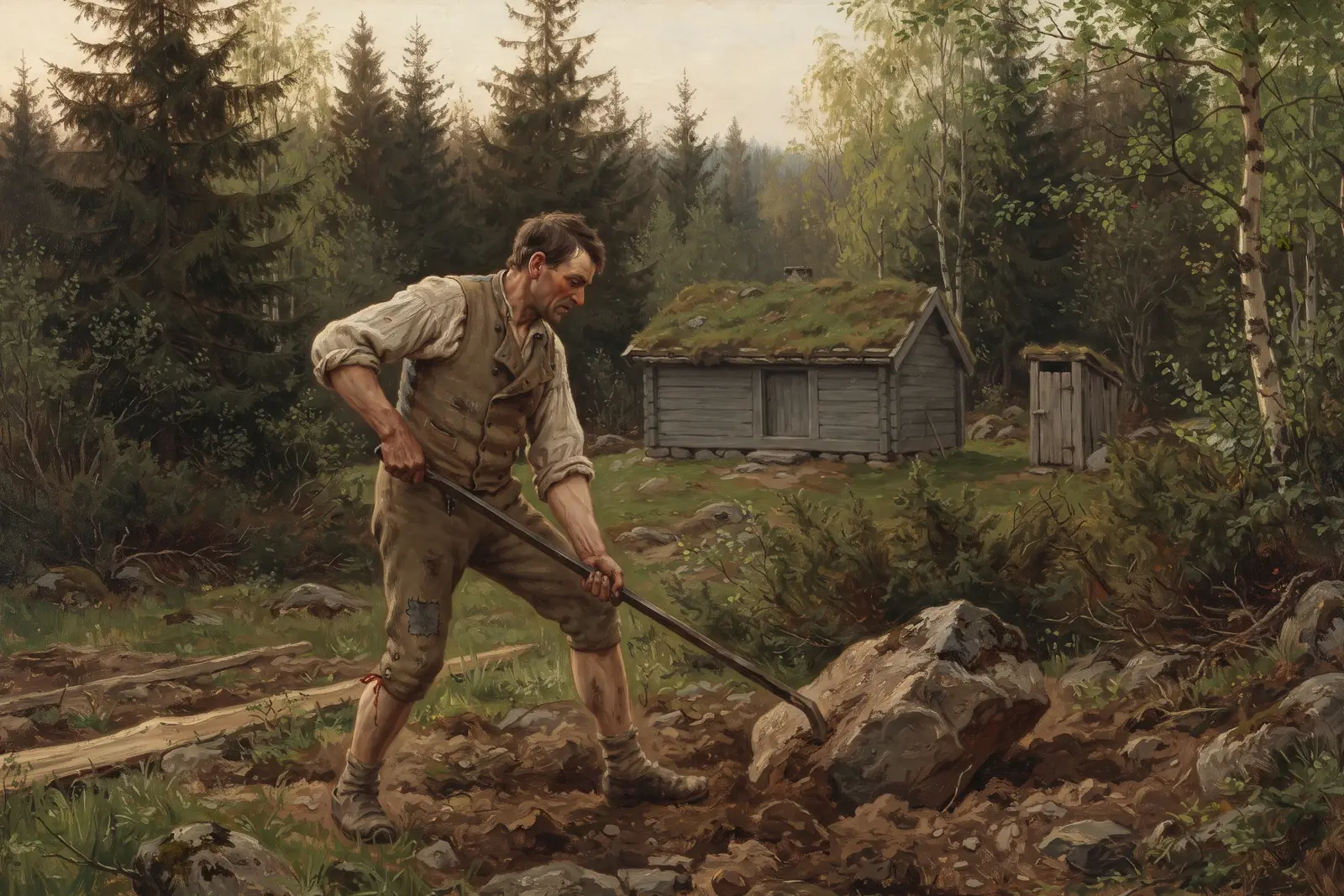
A torpare (crofter) farmed a small holding, a torp (croft), on land that belonged to someone else1,3. Usually he did not pay rent in money. Instead he worked a set number of full days a year on the landowner's farm or estate; these days were called dagsverken1,3. The word crofter is used in British English. In American English the closest term is "renter farmer"1.
In the records
In the household examination record, the title stands before the name, where the occupation is written5. The book is arranged by village, farm and croft6.
What it meant
The crofter used his own tools and animals on the land he was allowed to farm4. Crofters grew in number from the late 1700s to the 1860s4. Sweden had the most crofts around 1860, about 100,0001. From the 1870s there were fewer, mainly because of industrialization4. The system where the crofter paid with labor was forbidden in 19431,3.
Do not confuse with
A backstugusittare also lived on someone else's land, but did no days of work for a landowner4. A statare owned no land or animals and was a hired laborer, while the crofter had his own dwelling, cattle, fields and pasture2. Some English texts compare crofters with American sharecroppers, but Högman advises against it1. Today, torp in Swedish often means just a small cottage in the countryside1.
Related
- backstugusittare – A poor cottager who lived in a small cabin on someone else's land, with no land to farm.
- statare – A married farm laborer on a large estate, hired for a year and paid mostly in goods, called stat.
- bonde – A farmer – a man who worked his own or rented farmland in the countryside.
- Guide: How to Read Swedish Household Examination Records
Sources
Sources in English
- Hans Högman, Land ownership in earlier times – hhogman.se
- Hans Högman, Statare – hhogman.se
Sources in Swedish
These pages are in Swedish.
- Landsarkivet i Uppsala (Riksarkivet), Hur hittar jag mitt torp i arkiven?, Gunilla Lundberg Ehnström, 2008 (in Swedish) – webbutik.riksarkivet.se
- Länsstyrelsen Skåne (County Administrative Board of Skåne), De obesuttna (in Swedish) – lansstyrelsen.se
- Umeå University (CEDAR), Kyrkböcker. 1800-talets kyrkoregister, Ulla Nilsdotter Jeub, 2019 (in Swedish) – umu.se
- Riksarkivet, Kyrkoarkiv (in Swedish) – sok.riksarkivet.se
Facts checked against sources, November 2026.