What does husförhörslängd mean?
In Swedish records, husförhörslängd means household examination record: the priest's book of everyone in the parish, household by household, which priests had to keep from 1686.
- Swedish
- husförhörslängd
- In English
- household examination record
- Also seen as
- husförhörslängder, husförhörsbok, förhörslängd, församlingsbok
- Group
- Records
Definition
A husförhörslängd (household examination record) is the priest's book of everyone who belonged to the parish3. From 1686, Swedish priests had to keep such records of the whole population4. The book was arranged household by household3, by village, farm and croft5. In English it is also called a household examination roll or a clerical survey1,2.
In the records
Usually one household fills one page, with the head of the household at the top and the servants at the bottom6. The columns give occupation, name, date and parish of birth, marriage, reading marks, presence at the yearly examination, communion, smallpox vaccination, moves and death5,6. From about 1895 the book is called a församlingsbok (parish book)3,5.
What it meant
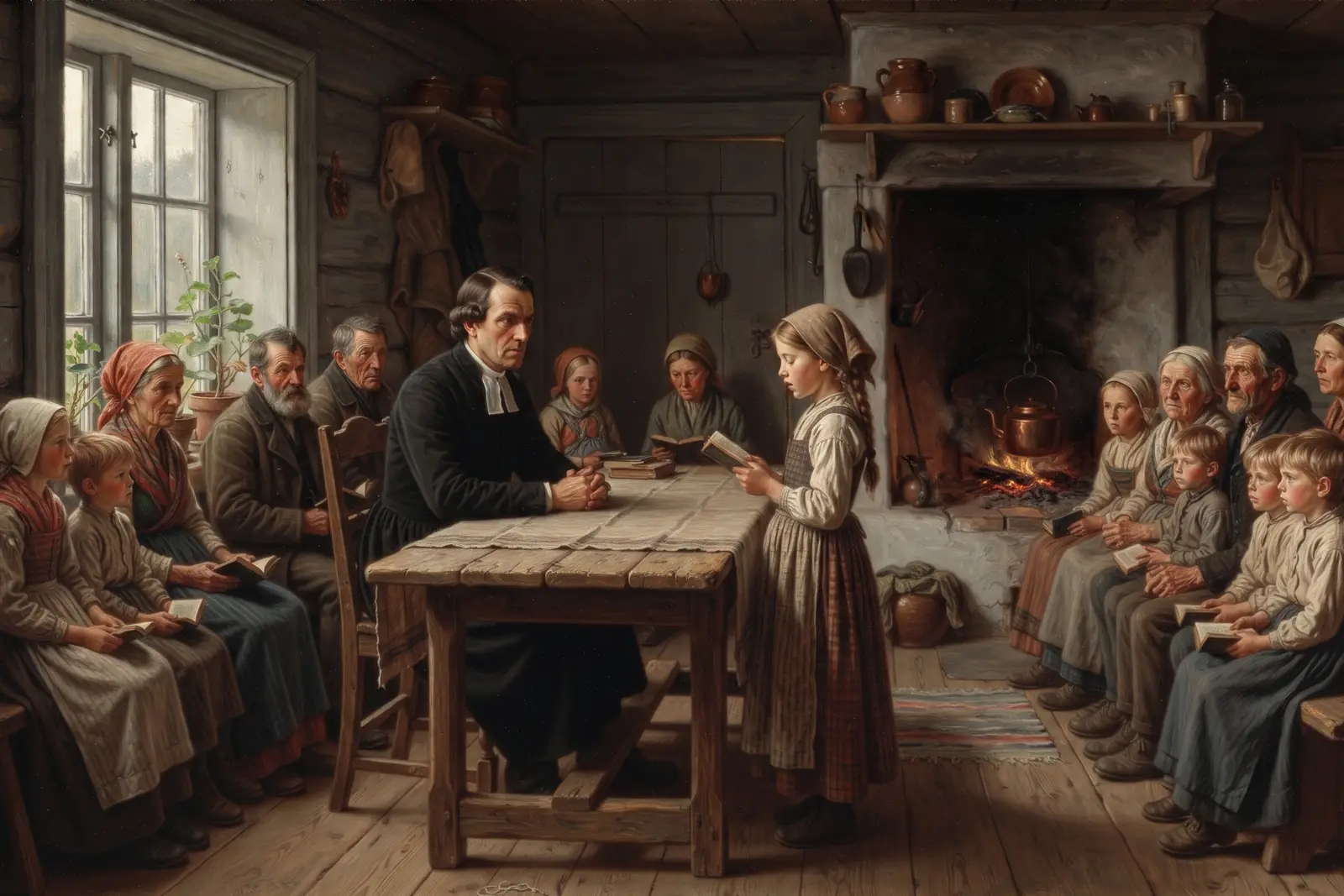
The name comes from the husförhör (household examination), when the priest visited the homes and tested reading and knowledge of the faith7. For a family historian, the record is the main book of the old Swedish population register, where facts from the other church records were gathered5,8. The old book often gives the page in the new one6.
Do not confuse with
The födelse- och dopbok (birth and baptism record) gives one child at a time: the parents' names and where they lived when the child was born. The household examination record shows the whole household5,8. The mantalslängd (tax register) more often has the latest occupation6. A death is noted in the household examination record, but the reliable date is in the death and burial record6.
Related
- socken – A parish – the area served by one church, and the unit the Swedish church records were kept by.
- Guide: How to Read Swedish Household Examination Records
Sources
Sources in English
- Riksarkivet (the Swedish National Archives), Genealogy – sok.riksarkivet.se
- Hans Högman, Genealogy terms A–R – hhogman.se
Sources in Swedish
These pages are in Swedish.
- Skatteverket (the Swedish Tax Agency), Ordförklaringar, Sveriges församlingar genom tiderna (in Swedish) – skatteverket.se
- Skatteverket, Folkbokföringens historia (in Swedish) – skatteverket.se
- Riksarkivet, Kyrkoarkiv (in Swedish) – sok.riksarkivet.se
- Umeå University (CEDAR), Kyrkböcker. 1800-talets kyrkoregister, Ulla Nilsdotter Jeub, 2019 (in Swedish) – umu.se
- Håkan Liby, Själavård, husförhör och folkbokföring, Uppland yearbook 1991 (in Swedish) – aarsbokenuppland.se
- Riksarkivet, Om släkt- och personforskning (in Swedish) – sok.riksarkivet.se
Facts checked against sources, November 2026.